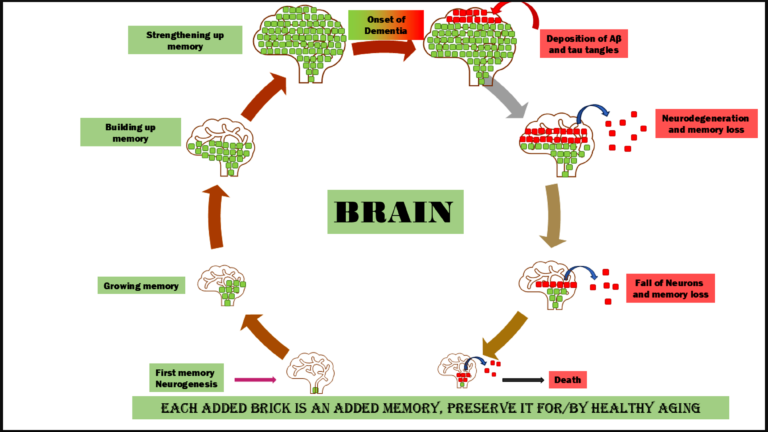
How Alzheimer’s Disease Begins and Progresses: The Building Metaphor
How Alzheimer’s Disease Begins and Progresses: The Building Metaphor
To understand how Alzheimer’s disease develops in old age, think of the human brain as a tall building, and the cells inside it called neurons as the bricks that make up the structure.
- Building the Memory Tower (Infancy to Adulthood)
From the moment we are born, our brain starts building a massive tower of memories inside cells called neurons:
- The Ground Floor (First Memories): Babies learn basic movements like turning over, sitting, crawling, standing, walking, and recognizing our parents. These are the very first bricks placed at the bottom of the tower.
- The Middle Floors: As we grow up, we add layers of daily activities, speaking, learning skills, professional skills, entertainment activities, extension of relations and friends
- The Top Floor (Recent Memories): Every new day, fresh memories are added to the very top like what you ate today or what you did yesterday.
For every single action or thought, these neurons communicate by sending quick electric and chemical signals called synaptic signals.
- The Trigger: Protection Turning into Harm (Inflammation)
As we go through life, our bodies face illnesses, accidents, and injuries. Whenever something harms us, the body responds with inflammation.
- Inflammation acts as our first protective guard, it rushes in to defend and heal us.
- However, as we grow older, repeated injuries and health issues can cause prolonged (long-lasting) inflammation.
- Instead of turning off, the body keeps secreting inflammatory chemicals for too long. These harsh chemicals slowly begin to damage and destroy nearby neurons.
- The Collapse: Top-to-Bottom Breakdown
When inflammation starts destroying neurons, the brain crumbles like a tall brick building falling from the top down:
Early Stage (Top Layer Loss): The uppermost, newest layer of neurons gets destroyed first. This is why a person in the early stages of Alzheimer’s forgets recent events (like where they put their keys or what happened an hour ago), but can still clearly remember things from long ago.
Middle Stage (Going Deeper): As prolonged inflammation continues, the destruction moves deeper layer by layer. Middle-aged memories, complex routines, and recent life details begin to fade.
Late Stage (The Foundation Collapses): Finally, the fall of neurons reaches the deepest layers—the foundational memories stored right at the beginning of life. At this stage, the person loses the ability to recognize close family members, turn around in bed, or walk.
Protection at the early stage of AD
We may not be able to rebuild the bricks that have already fallen.
Early biomarker in the blood or brain fluid showing that neurons are under stress and inflammation can detect at initial stage by catching the damage early, we can clear away the harmful inflammatory chemicals and fortify the rest of the tower before the deeper layers are touched. Thus, early phase of cognitive impairment can be saved to reach AD.
The figure illustrated the brain structure from infant to adulthood in Alzheimer’s Disease: